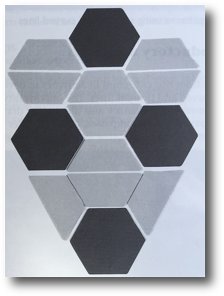
Shape puzzle
Pupils make a 3-piece shape puzzle to explore.
They start with a square. Draw the diagonals lightly in pencil, only including half a diagonal for one of them.
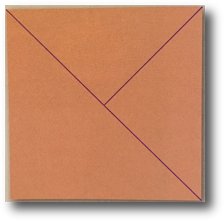
Cut along one diagonal and then the other line to make two smaller triangles.
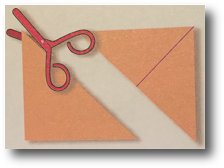
- Which shapes can they make from the two small triangles?
- Which shapes can they make from all three triangles?
Make a shape that has the largest number of sides.
Design your own 3-piece shape puzzle from a square.
Make and sort 4-sided and 5-sided shapes.
Half and half
This is half a shape.
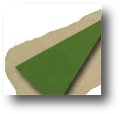
The whole shape can be any of these.
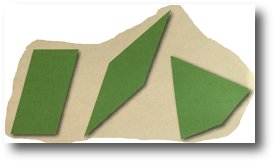
Pupils choose their own 'half shape' from a selection of tile or card shapes. They explore the whole shapes that can be made from two of the half shapes.
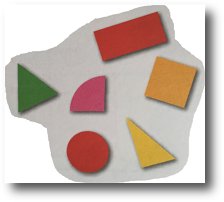
Can they sort the shapes they make by different criteria?
Extend the activity by starting with a shape that is a quarter of a whole.
Paint devils
- Fold a sheet of paper in half.
- Put blots in different positions – on the fold or to one side. Experiment with colours, position and size of blot.
- Fold the paper and smooth out.
- Open the paper to find a symmetrical pattern.
- Move a mirror around the completed blot and look at the patterns.
Pupils should experiment folding the paper twice; once in one direction, then opened out before folding in a different direction.
Gummed paper shapes
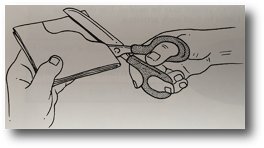
- Fold gummed paper into halves or quarters.
- Cut an interesting shape from the corner.
- Open out to see a symmetrical shape.
- Stick down the shape on white paper.
Pegboards and pegs
One pupil makes a pattern on half the pegboard then the other pupil creates its mirror image.
An elastic band stretched across the pegboard can act as the mirror line, or line of symmetry.
Dollies and snowflakes
- Fold a sheet of paper into eighths.
- Cut notches and shapes out of the edges to create symmetrical doilies or snowflakes.
Encourage pupils to experiment in producing a symmetrical snowflake which pleases them. They can make hexagonal and octagonal snowflakes.
Pin-prick reflection
Pupils fold a sheet of paper in half and draw a simple straight line shape.
They pin-prick through the paper at each vertex.
The paper is opened out and lines are drawn to join the pin pricks to make the symmetrical shape.
String patterns
- Soak about 30cm of string in paint.
- Fold a sheet of paper in half.
- Place the string on one half in a spiral or squiggle.
- Fold the paper and press down firmly.
- Still pressing down, pull the string out.
- Open the paper.
- Repeat with different colours.
- Move a mirror over the finished pattern and look at the patterns.
Symmetrical cut-outs
- Place two sheets of different coloured card together and cut pieces out.
- Arrange the pieces to make symmetrical pictures or patterns.
Circle chops
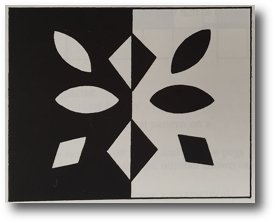
- Cut two gummed circles (held together) into several parts.
- Stick down the pieces to create symmetrical patterns.
- Repeat for different ‘circle chops’.
Pupils check that colours and shapes make a symmetrical pattern.
Concertinas
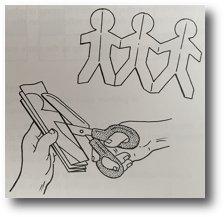
- Fold strips of paper zigzag in to a concertina.
- Cut a simple figure from fold to fold.
- Open out the strip to see the symmetrical concertina picture.
Drawing reflections
Organisation: Working in pairs
Pupils use squared, isometric or spotty paper which has a line drawn down the centre, or diagonally.
One pupil draws a shape or some lines on one half then a partner draws the reflection on the other half.
Coloured patterns can be built up in the same way.
Multilink pegboards
Organisation: Working in pairs
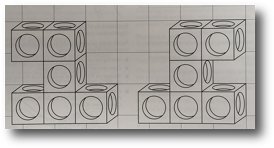
Pupils work in pairs using a Multilink pegboard or 2 cm squared paper. They place a sheet of card which has a mirror line drawn on it under the pegboard, or fold the squared paper in half.
- One pupil begins to make a model on one side of the mirror line with Multilink pieces.
- The other pupil creates a reflection of the model.
Encourage pupils to work ‘upwards’ from the pegboard so that they are working in three dimensions.
Gaps or no gaps?
Each group needs a set of 2D shapes. Ask pupils to make two piles of shapes, those which tessellate and those which do not.· Explain that tessellation means covering without leaving gaps.
· Focus on the shapes that do tessellate and ask pupils to sort these shapes.
Which four-sided shapes tessellate?
Which curved shapes tessellate?
· Focus on the shapes that do not tessellate and discuss them.
Are there any triangles in this set?
Are there any shapes here which surprise you?
Rectangle pattern
Pupils need a set of rectangles or a rectangle template. Ask them to make as many different tessellating patterns as they can using their rectangles. 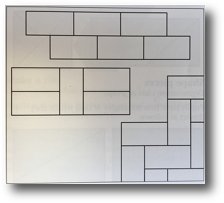
Tessellation display
Pupils create a display area of tessellations they have found or made. This can include wall paper samples, fabrics, clothing, drawings, newspaper pictures, ...
Dissections
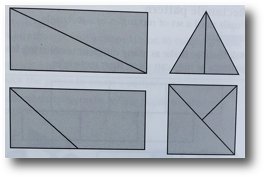
Organisation: class or groupsPupils cut up a shape into two or three pieces and rearrange the pieces to make new shapes.
Each new shape should be described as accurately as possible with the help of a glossary.
Possible dissections include:
Shape pieces
Organisation: class or groupsPupils have four rectangles of card which they dissect as follows:
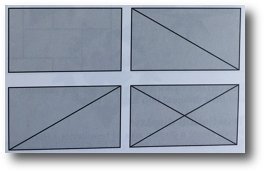
Triangle pin trap
Organisation: Working in pairs
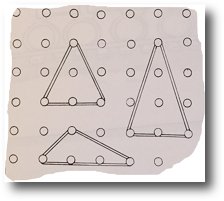
Pupils make triangles on a geoboard.
- Which triangles will trap one pin inside?
- Which will trap two pins, three pins...?
- Are your triangles different? How?
- What is the largest number of pins you can trap?
Pupils can record their results on spotty paper or by taking photos.
Pegboard game
Organisation: Working in pairs
- Pupils make a symmetrical pattern on a pegboard.
- They take turns to roll a dice and remove pegs from the board to match the number shown on the dice.
- The player who fails to leave a symmetrical pattern after their turn loses that round of the game.
- They play a predetermined number of rounds.
Discuss with the pupils odd totals and even totals and the strategy for dealing with odd totals (a peg must be removed from a line of symmetry).
Tiles
Organisation: Whole class working in co-operative groups
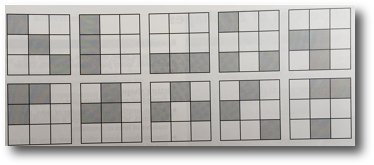
Pupils draw several 3x3 tiles on a squared paper. On each tile they colour in three of the small squares.
How many different tiles can you make?
Which of the tiles are symmetrical?
Ask each group to make some patterns using a combination of different tiles.
Then ask them to choose one tile and make different repeating patterns. Each pattern must be symmetrical.
Polygon symmetry
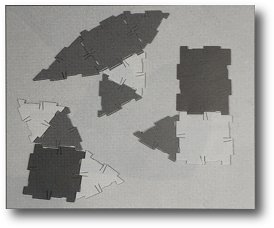
Pupils clip shapes such as polydron or clixi together to make some polygons. They sort those polygons which have lines of symmetry.
Challenge them to make some interesting shapes which have lines of symmetry.
No symmetry
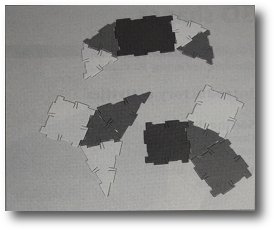
Pupils clip pairs of shapes such as polydron or clixi together. The new shapes must not have line symmetry.
They draw and name some of their non-symmetrical polygons. Freehand sketches can be used.
Colour and shape symmetry
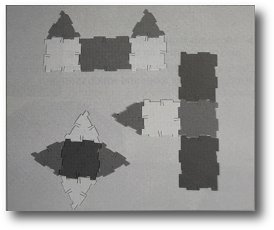
Pupils make a symmetrical shape by clipping together different coloured squares from polydron or clixi pieces.
The colour pattern must also be symmetrical. They can draw some of their patterns on Spotty paper.
This can be repeated using different-shaped pieces.
Behind the wall
Hide different shape tiles behind a ‘wall’ such as a large book or screen. Slowly reveal the shape and ask the pupils to name it once they recognise it. They then give four facts to describe each shape.
Sorting shapes
Pupils sort shape tiles in different ways.
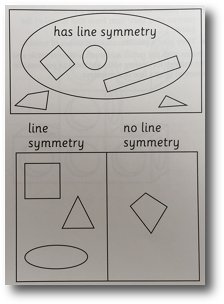
Sort by length of sides, number of sides, number of corners, whether the shape is symmetrical, number of lines of symmetry.
Discuss those shapes which have more than one line of symmetry.
Shapes such as the parallelogram often raise queries because although they are symmetrical they do not have line symmetry – they only have rotational symmetry.
Pupils should use Venn, Carroll and tree diagrams to sort and classify a varied collection of shape tiles.
Geoboards
Organisation: group
Ask pupils to make a 2D shape on their geoboard. They repeat this for different shapes. Results can be drawn on to Spotty paper.
Ask how many symmetrical three-sided and four-sided shapes can be made on a nine-pin board. Ask which other symmetrical polygons can be made.
Sorting diagrams
Carroll, Venn and tree diagrams can be used to sort and classify 3D shapes.
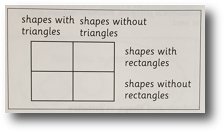
- Pupils sort 3D shapes on to simple Carroll diagrams.
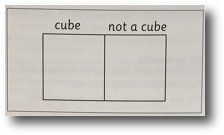
- They examine the faces of 3D shapes then sort and classify the shapes on to more complex Carroll diagrams.
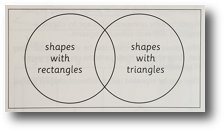
- Ask pupils to examine the faces of 3D shapes and to sort them on to a Venn Diagram. Discuss the properties of the shapes which do not belong inside the loops and which must be placed outside.
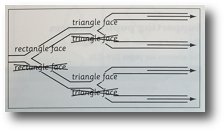
- Pupils sort shapes on a tree diagram. Change the criteria used at each fork of the tree diagram.
Four face facts
Organisation: whole class in pairs
Hold up 3D shapes and ask pupils to name the different faces. Ask them to work in pairs to give four properties of each of the shapes named, e.g. square: 4 equal sides, 4 equal angles, a special rectangle, symmetrical.
Shape challenge
Organisation: groups
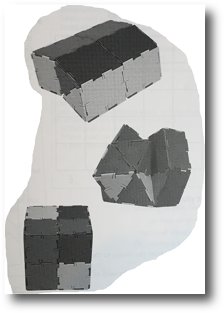
Use Clixi or Polydron. Challenge pupils to:
Make strange prisms. The end of each prism must not be symmetrical. Draw the ends of the prisms.
Make an interesting 3D shape. Each face must look different. Write about the 3D shape and draw the faces.
Make a 3D shape which has a colour pattern on each face. Draw each face of the 3D shape.
Make a 3D shape which has a concave face. Pupils draw or describe their concave shape.
Tessellating tiles
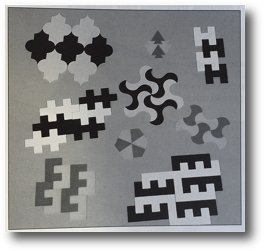
Organisation: groupsPupils use tessellating tiles to make patterns. Many sets of such tiles include curved shapes and unusual 2D shapes such as concave shapes.
Two-tile patterns
Organisation: groupsPupils choose two different shapes and make tessellating patterns from them.